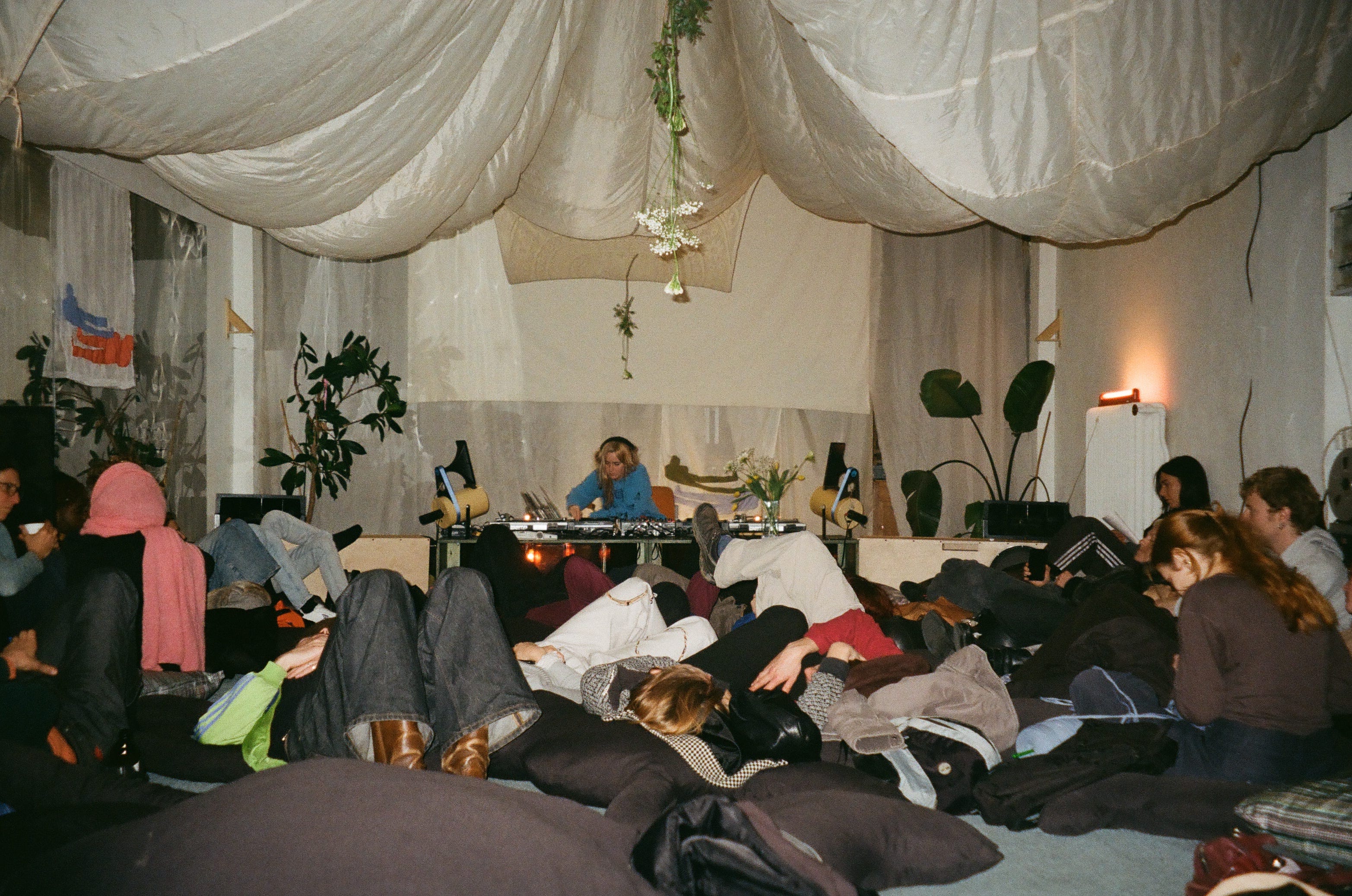
I used to think music was what made a scene.
It seemed obvious.
Techno people listened to techno.
Punks listened to punk.
Metalheads listened to metal.
Swifties listen to Taylor Swift.
People gathered around a sound, developed aesthetics and rituals around it, found venues where it could exist, and eventually something resembling a community emerged.
Music first.
People second.
Recently, I was sitting at an afterparty talking about this with a friend.
It was late enough that conversations had started becoming either completely meaningless or unexpectedly philosophical.
We were talking about what actually makes a scene a scene.
And I said:
The music.
Obviously.
But the longer we talked, the less convinced I became.
Because I started thinking about all the people I have met through nightlife, and how many of them I feel connected to in ways that have almost nothing to do with what they listen to.
Maybe music isn’t actually what connects us.
Maybe it is just how we found each other.
There is something strange about meeting people through a scene.
On paper, they can be completely different.
Different countries.
Different jobs.
Different ages.
Different childhoods.
Different politics.
Different ways of living.
People who probably never would have encountered each other through ordinary life suddenly spend twelve hours together in a warehouse.
And somehow it works.
Not always.
But often enough that you start wondering what the common denominator actually is.
Because it cannot simply be BPM.
There are millions of people who like the same music as me whom I probably wouldn’t particularly like.
And there are people whose musical taste barely overlaps with mine whom I immediately recognise as somehow being my kind of person.
So what exactly are we recognising?
Maybe a scene is less about shared taste than shared orientation.
A certain way of looking at the world.
Curiosity.
Openness.
A tolerance for unconventionality.
A willingness to stay awake too long because something interesting might happen.
An attraction to intensity.
A suspicion of overly prescribed lives.
A desire to make things rather than simply consume them.
Maybe even a particular relationship with freedom.
None of these qualities belong exclusively to rave culture.
And certainly not everyone in nightlife possesses them.
But perhaps scenes form when enough people with some overlapping orientation towards life repeatedly find themselves in the same places.
The music gives them a reason to arrive.
The people give them a reason to return.
Maybe that is why discovering a scene can feel so intense.
You think you discovered music.
But sometimes you actually discovered a social possibility.
Oh.
There are people like this.
People who stay up talking until breakfast.
People who make things for no obvious financial reason.
People who organise parties knowing they might lose money.
People who obsess over obscure records.
People who will lend someone they met three hours ago a jacket, a cigarette, a phone charger, a place to sleep.
People who have built lives slightly outside whatever was expected of them.
Suddenly your own strangeness becomes less strange.
There is a world for it.
But then something even more interesting happens.
You spend enough time inside a scene and realise:
There isn’t actually one scene.
There are scenes within scenes within scenes.
The same genre can contain completely different social worlds.
The music-head scene.
The queer scene.
The free-party scene.
The fashion scene.
The day-party scene.
The political scene.
The druggy scene.
The older heads who have been doing this for twenty years.
The younger crowd who arrived six months ago and are already starting collectives.
And then there are tiny groups that don’t even have names.
Twenty people who keep appearing at the same parties.
A loose constellation of people who somehow recognise each other.
Same city.
Same music.
Completely different worlds.
And perhaps this explains why two parties can book almost identical lineups and feel nothing alike.
Technically, the music is the same.
But the room isn’t.
One feels competitive.
Another feels tender.
One feels like everyone is looking around to see who else is there.
Another feels like nobody cares.
One feels fashionable.
Another feels strange.
One feels like an audience.
Another feels like a community.
You cannot put this on a flyer.
Because what you are experiencing is not musical programming.
It is social composition.
Who invited whom.
What behaviours the organisers tolerate.
Whether people know each other.
Whether newcomers are welcomed.
Whether status matters.
Whether people contribute.
Whether the room feels like somewhere to be seen or somewhere to disappear.
A scene is an atmosphere produced by people.
Music can organise the meeting.
But people create the meaning.
This also explains why scenes can change while the music stays almost exactly the same.
Someone leaves.
A collective dissolves.
A venue closes.
Ten new people arrive.
Someone starts throwing parties.
Someone becomes successful.
Someone moves away.
Suddenly the emotional centre shifts.
Because scenes are not objects.
They are relationships.
And relationships are unstable.
Maybe this is why people become so protective of them.
Why conversations about newcomers, commercialisation and “the wrong crowd” become so emotional.
Sometimes people say they are protecting the music.
But perhaps what they are actually afraid of losing is a particular social chemistry.
A feeling that existed between a specific group of people at a specific moment.
And this is where nostalgia becomes dangerous.
Because we start believing that chemistry can be preserved by controlling who enters.
It can’t.
Scenes need permeability.
New people bring new ideas, energy, music and relationships.
Without them, communities become museums of themselves.
But openness changes things too.
Every new person slightly alters the experiment.
That is the contradiction of community:
We want it to remain what we love while also remaining alive.
And we cannot have both without change.
The philosopher Martin Buber distinguished between relating to people as objects and encountering them as genuine others.
I think about that sometimes in nightlife.
Because the most meaningful scenes are not simply networks.
They are places of recognition.
You stop being:
DJ.
Promoter.
Photographer.
Foreigner.
Regular.
Newcomer.
Useful contact.
Person-with-guestlist.
Brother of…
And occasionally, underneath all of that, you actually meet.
This is why some of the most important moments in nightlife happen nowhere near the dancefloor.
Smoking areas.
Train journeys.
Kitchens.
Car rides.
Breakfast.
The pavement outside the club.
Afterparties where somebody suddenly asks a question that changes the way you think about the scene you’ve been part of for years.
Like this one did for me.
I still think music matters enormously.
Without it, many of us would never have entered these rooms.
Music creates the language.
It creates the ritual.
It creates the excuse.
And sometimes it creates those rare moments when hundreds of completely different people suddenly move as though they are one organism.
But I no longer think music alone makes a scene.
A playlist cannot create trust.
A BPM cannot build a soundsystem, clean a warehouse, start a label, lend you money, challenge your behaviour, give you a sofa to sleep on or tell you when you’re becoming an asshole.
People do that.
A record can introduce you to someone who might become your best friend.
But maybe music is simply the frequency we use to find one another.
We hear something in it.
And somewhere else, another person hears something similar.
Not necessarily the same thing.
Just enough.
So we follow the sound.
We arrive at the same places.
And then slowly, almost accidentally, something begins forming between us.
Friendships.
Arguments.
Love affairs.
Collectives.
Rivalries.
Ideas.
Parties.
Entire little worlds.
Eventually you look around and realise that what you thought was a music scene has become something much harder to define.
A network of people who, despite all their differences, seem to recognise something in one another.
Not necessarily the same taste.
Not the same politics.
Not the same life.
Just some shared instinct about how life might be lived.
Maybe that is what a scene really is.
Not a group of people who listen to the same music.
A group of people who somehow found each other through it.